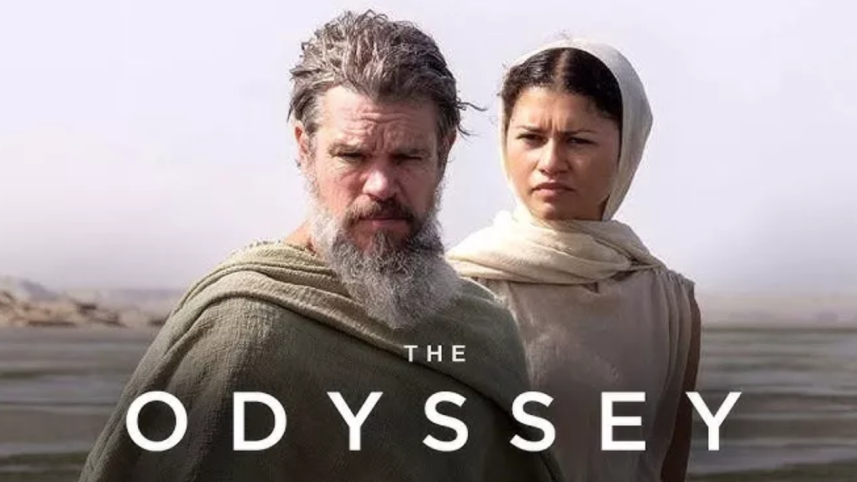
The Odyssey Review
Christopher Nolan’s Odyssey is a gorgeous and captivating rendition of a thrilling and timelessly thought-provoking tale, technically impressive and unquestionably worth seeing. One thing it’s not is Homer. That’s okay. Nolan makes choices that fundamentally alter the main character, his motivations, and the moral and theological structures of the world in which he lives. In doing so, he follows in the footsteps of such geniuses as Plato, Virgil, Dante, and Tennyson.
Watching the Odyssey is a treat. The costumes, in particular the armors of Agamemnon and the Trojans, are especially creative. The soundtrack gave the right emotional cues without competing for my conscious attention (although it sometimes competed with the dialogue). The cinematography was beautiful and managed to make scenes feel intimate even in IMAX.
Like anyone who adapts the written word for the screen, Nolan had to adapt. He had to make changes, fill in details that the poet left out, and add or remove story. Some of these were much discussed on social media before the movie’s release, but none should keep readers from seeing the Odyssey. Regardless of the actors’ race or gender, the characters are all Greek men. Press reports may have justified worries that the movie is a Trojan horse for “woke” ideology, but Nolan uses his gifts differently than his title character used his. If there are any hidden Greeks in this movie, they have absolutely nothing to do with race and exactly as much to do with gender as Homer’s version (which is, to be clear, a fair amount).
It is the changes not deplored on social media that make this Odyssey thought-provoking. (Adding a spoiler-alert for a three-millennia-old story is absurd, but consider yourself warned.) First, the gods have less to do with this story than in the poem, and their nature is changed. They are never depicted in conflict with each other, which makes Nolan’s Odyssey less the story of a man tossed about by the conflicting gods and more the story of a man slowly reconciling himself to the divine will. In that sense, it has more of Jonah than Homer. Only Athena ever appears on screen. For Homer, she drives much of the action, but Nolan only depicts her inside Odysseus’ mind, and whether she is real or merely imagined is never clear. Odysseus even grapples, twice, with divine hiddenness, asking Athena why the gods don’t speak in ways that mortals understand. Athena’s answer: “Who doesn’t understand the smile of a child, or a clap of thunder?” indicates that Nolan intends his Odyssey’s theology to have more to say about God to a Christian or post-Christian audience than the original did.
Second, Nolan reframes Homer’s xenia, or the code of conduct governing how to treat foreigners and strangers, into “Zeus’ Law,” which Telemachus (in the only moment that reminded me that I was watching a movie) describes as “treat others as you would like to be treated, since they may be gods in disguise.” Zeus’ Law is as central for Nolan’s characters as xenia was for Homer’s, so the shift from hospitality to reciprocity is worth noticing.
Third, while Nolan largely follows the chronology of the poem, he omits entirely the Phaeacia sojourn during which Homer’s Odysseus recounts the stories from Troy; instead, he recalls them to Calypso. The poem left ambiguity about whether Odysseus was telling the truth about his adventures, but the movie leaves little to none.
The most substantial change is the character of Odysseus. Consistently, Nolan chooses to make Odysseus more palatable to an audience that has had its moral imagination shaped by Christian views of mercy and justice. Thus Homer’s Odysseus seeks glory and riches without shame or even introspection, but Nolan’s Odysseus is haunted by his responsibility for the razing of Troy and the deaths of his men. Homer’s Odysseus dallies at the house and in the bed of Circe for a year, and with the goddess Calypso for seven. But Nolan’s Odysseus encounters Circe both briefly and chastely, and his stay with Calypso is plausibly for medicinal purposes only: she feeds him the lotus flower (making him forget home) to help him recover mentally from his catastrophic journey. Thus, while Homer’s Odysseus chooses infidelity to his wife and delinquency from his home for the better part of a decade, Nolan gives his Odysseus an argument that his own moral agency has been compromised by circumstance.
Softened too is the climactic showdown between Odysseus and the suitors. In the poem, Odysseus slays suitors who beg for their lives; in the movie, any suitor who kneels during the fight is spared. In the poem, the serving girls who have slept with the suitors must clean up the corpses and blood of the dead before being hanged; in the movie, one serving girl is punished less graphically. In the poem, Odysseus is heavily concerned with returning home with riches and gifts to restore his estate from the ruin of the suitors; in the movie, there are no riches to speak of and instead a duty to avenge the wrongs done to the family of Sinon.
Another change is that characters mention the “Sea Peoples,” who have been pillaging and destroying Bronze-Age civilizations across the Mediterranean. Nolan uses this (real and mysterious) group of raiders to drive tension at home on Ithaca, and to justify the film’s central moral message, which is that the Greeks’ violation of Zeus’ Law by using the Trojan Horse has, like some form of Original Sin, so fractured the proper relationship between men that civilization is crumbling from violence. Nolan might even be suggesting that this is meet and just, but that future civilizations (i.e. ours) could learn from the mistakes of the past and save ourselves before it is too late.
Given the modification of xenia into the Golden Rule, the repeated references to the problem of divine hiddenness, and the fact that Nolan’s Odysseus confesses his role in the looming end of the Bronze Age anonymously through a screen, one wonders if Nolan is trying to speak specifically to those who feel as though we are on the precipice of transitioning to a post-Christian society.
Great art (and this is great art) holds up a polished shield to society, and in this case our society will see different things than Homer’s listeners heard. Nolan has thus spoken a different interpretation into the culture than Homer.
But this has always been true, and Nolan has as much right to Odysseus as any of the other great artists who have told his story. Plato, in his Republic, envisions Odysseus in the afterlife, wiser from his travails as told by Homer, choosing to be reincarnated as an unknown man living a private life. Virgil, crafting the national epic of the Roman Empire, makes wily Odysseus the foil to pious Aeneas. Dante places the deceitful Odysseus in the Comedia’s hell for his role in the perfidy of the Trojan horse, and even invents a new sin for Odysseus when he has him smitten for sailing to reach Mount Purgatory on his own. Tennyson paints Odysseus as a slave of indomitable wanderlust, weary of his old wife and dull hearth, and determined “to strive, to seek, to find, and not to yield.” Nolan’s Odysseus is in dialogue with three millennia of Odysseuses, and do not be surprised if a thousand years hence storytellers inherit Odysseus not just as a man of many twists and turns, a wily deceiver, a damned sinner, or a restless wanderer, but also as a king racked with guilt for the civilization he helped to end.